Seattle Since the 1960s
How much Seattle has changed since JFK’s era
Nov. 22, 2025 at 6:00 am Updated Nov. 22, 2025 at 6:00 am
Downtown Seattle is in the background of this photograph taken from the Goodyear Blimp Mayflower II, as it circled over the World’s Fair. (The Seattle Times archive)
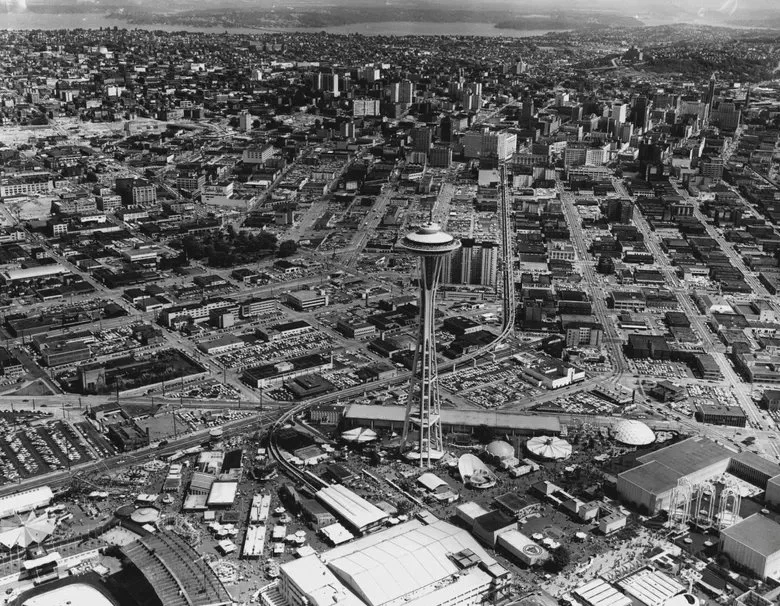
Downtown Seattle is in the background of this photograph taken from the Goodyear Blimp Mayflower II, as it circled over the World’s Fair. (The Seattle Times archive)
By Jon Talton Seattle Times columnist
As most longtime Seattleites and historians know, President John F. Kennedy intended to visit the final day of the successful Seattle Century 21 World’s Fair on Oct. 21, 1962, but he didn’t.
As the online site HistoryLink puts it, “He bows out with ‘a “cold,” ‘interrupting a nationwide tour to return to Washington, D.C., for ‘bed rest.’ This is a ruse.” In fact, he was dealing with the Cuban missile crisis.
With Americans marking the 62nd anniversary of Kennedy’s assassination in Dallas this week, it’s a moment to reflect on how the economy fared during his era.
In Seattle, Boeing was the city’s largest headquartered company and private-sector employer. It revolutionized jet travel with the introduction of the 707 in 1958. Seattle was “Jet City” for the jet age and jet set.
Boeing was a major defense contractor, too, with such iconic products as the B-52 Stratofortress, still in service, and the space program.
In 1963, Seattle, with a population of about 557,087, was still heavily blue collar, with canneries, factories, the fishing fleet and the port.
At the time, many ships were still unloaded by longshore workers using cranes and hoists to load cargo onto trucks for the road or nearby railway yards. Container shipping was on the way. The city enjoyed freight service from four transcontinental railroads (and passenger trains from three serving two downtown stations).
Then, “social networking” was done in beauty parlors and barber shops. Advanced communications meant dial telephones for the average households, from Pacific Northwest Bell, headquartered here and part of the Bell System before the 1984 breakup of the old AT&T.
Seattle, like most large cities, enjoyed two newspapers, and readership was high. These were the days well before artificial Intelligence, the internet revolution and its consequences for Seattle.
In addition to promoting Seattle to the nation and the world, the Century 21 event was part of an effort to bring new industries to diversify the economy. Another aim: help a downtown challenged by suburban sprawl. Even though Interstate 5 hadn’t finished severing the central core from neighborhoods to the east, Northgate Mall, the first in the country, opened in 1950 on the northern fringes of the city. Competition for downtown was growing.

In addition to promoting Seattle to the nation and the world, the Century 21 event was part of an effort to bring new industries to diversify the economy. Another aim: help a downtown challenged by suburban sprawl. Even though Interstate 5 hadn’t finished severing the central core from neighborhoods to the east, Northgate Mall, the first in the country, opened in 1950 on the northern fringes of the city. Competition for downtown was growing.
Even so, most residents shopped downtown, which was blessed with such department stores as the beloved Frederick & Nelson and The Bon Marché, as well as a dense, walkable streetscape of local and national retailers. It was a destination for its restaurants, offices and local banks.
Antitrust laws were enforced, so while major national firms such as Sears and Woolworth prospered, local business ownership was the norm.
Abundant federal funding for highway construction, GI Bill assistance for many World War II and Korean War veterans to purchase houses, and other programs powered suburban sprawl.
Seattle’s population fell nearly 5% in the 1960s, largely because of the rise of suburbs.
According to the 1960 census, white people made up nearly 92% of the population (compared with about 62% now). Yet, as with all American cities of the era, Seattle was highly segregated.
“Tight segregation (in real estate) remained the rule” in 1960, as James Gregory wrote for the University of Washington’s Seattle Civil Rights and Labor History Project.
He wrote that racial discrimination “remained fully legal and widely practiced by real estate agents, landlords, white property owners, and neighborhood associations. Nearly all Black, Asian, and Native American families were locked in a triangle of census tracts in the Central District and Chinatown. Small pockets of Black residents remained in the High Point housing project in Southwest Seattle, but the number living in Sodo and Georgetown area had declined along with the total population (as) housing in these areas gave way to freeways, warehouses, and industrial sites.”
Kennedy’s civil rights program was stuck in Congress, where segregationist Democratic Southerners held powerful committee positions.
Kennedy edged out Vice President Richard Nixon (who accepted defeat) in 1960, partly because the nation was in a recession. Among the economic policies of the Kennedy administration were increasing the minimum wage, bolstering unemployment protection and lowering taxes. He and his whiz kid advisers also wanted to use federal military spending to help with recovery.
As discussed in an article by University of Virginia history professor Marc Selverstone, “The president also proposed new social programs including federal aid to education, medical care for the elderly, urban mass transit, a Department of Urban Affairs, and regional development in Appalachia.”
Yet most of these were weakened, and such programs as civil rights and Medicare would have to wait for Kennedy’s successor, Vice President Lyndon Johnson.
# # # # # #