What people are saying
Barbara Stenson, award winning Seattle journalist
“Coming of Age is a rare view of the world of young women and the people who loved them, living in the fast-changing, booming, progressive post-WW II Pacific Northwest.”
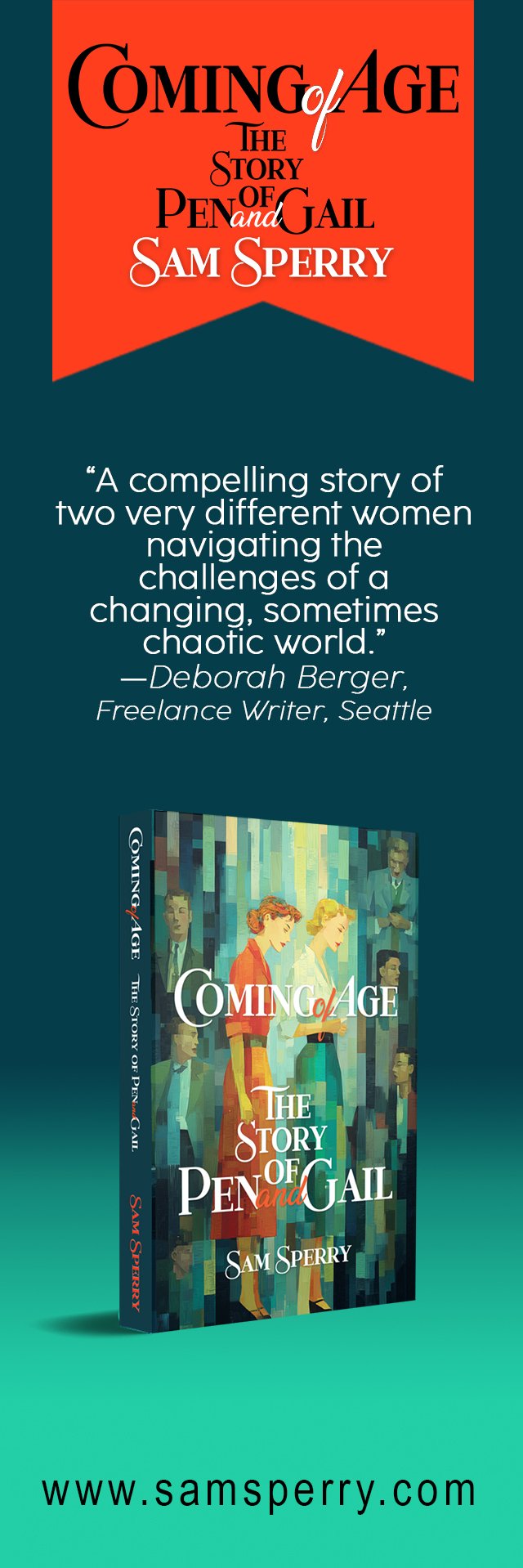
Lynne Pearson, author and editor, Kirkland, WA.
“Thank you for introducing me to Pen and Gail, two compelling women who used their privilege to improve the lives of many Washington state residents during their lives. Sperry’s done a good job of weaving together the times they lived through, Washington state’s history, and the challenges of being women in business.”
Margaret Pageler—JD, former Seattle City Council Member
“I was struck by how Pen's personal exposure to black and Chinese classmates at Garfield High primed her for leadership in the civil rights movement during college and early adulthood. She saw Henrietta and Si-Ling as people, not causes.”
Michele Hasson—Development Director, Arts and Healthcare
“Amazing. I have two new friends named Pen and Gail. I met them through your delightful saga of their growing together as besties and as women. It's my kind of book - a hefty 400 pages filled with landmarks of my city during a period of time that I can remember.
Jennifer Hermiston, Seattle, Educator and Library Media Speciualist
“The Seattle references feel vivid and authentic, and they gave the story a warmth I really appreciated. I also enjoyed the themes of friendship, resilience, and the challenges women faced. As I read . . . I could always feel the care behind the story, and [the author’s] affection for these characters and this place comes through.”
Tony Robinson—Former Columnist, Seattle Post-Intelligencer
"This is, to be sure, a story of strong and capable women really in advance of the larger feminist movement. The principals, Pen and Gail, are not the only strong women in the story.”

David Brewster, Seattle, Editor Post Alley, Founder Town Hall, The Seattle Weekly
“Sam Sperry really knows Seattle from the inside, and he gets how much aspiration drives its citizens. He tells a very touching story of friendship of two women from opposite economic
backgrounds, and produces an economic parable for the city.”